The Shape of My Cold
My cold since yesterday didn't heal yet. So I'm back again looking deeper into it.

This thing is the rhinovirus. The culprits behind more than half of the cases of common cold. They come in about 160 different varieties, all sharing the same shape.
Now about that shape.
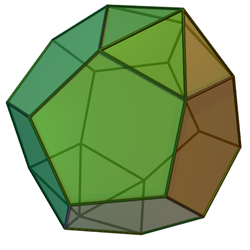
If you look at the image closely, you will see pentagonal arrangements. Counting the pentagons, there are a total of 12. And as 12 in Greek is 'Dodeca', we can say that it is the famous Dodecahedron.
Except, scientists do not say that. Rhinovirus is popularly always defined as Icosahedral.
Here are Dodeca and Icosa for reference:
|  |
|---|
Dodecahedron and Icosahedra are actually duals of each other. Meaning, you get the other by switching faces for vertices and vertices for faces. So while they both have the same 30 edges, Dodeca has 12 faces (and 20 vertices), while Icosa - meaning '20' in Greek - has 20 faces (and 12 vertices).
The Wikipedia article states that while the virus is dodecahedral in structure, the proteins are assembled as an icosahedron. Which is interesting but half ass backwards, because there is no virus-structure separate from the proteins themselves.
Here is a study from 2012:
In Vitro Assembly of an Empty Picornavirus Capsid follows a Dodecahedral Path - PMC
"One final point is that, although by convention picornaviruses (and most other spherical viruses) are described as icosahedral, an icosahedron of 20 triangles and a dodecahedron of 12 pentagons have the same 5-3-2 symmetry, and both are composed of 60 asymmetric units related by the same symmetry matrices (3). Here we have demonstrated that BEV follows a dodecahedral assembly mechanism and thus, from the perspective of assembly, we suggest that BEV and other Picornaviridae be considered dodecahedral viruses."
Appears that the scientists are caught in outdated verbal conventions with regards to viruses.
Interestingly, the same Wikipedia article, right adjacent to where it claims rhinoviruses are icosahedral, showcases the following diagram taken from Frontiers - which article too claims it to be icosahedral:

If we look even closer at the first image of the post, we find that the pentagons are not flat, but are bulging at the center. Giving them a very distinct resemblance to a specific kind of dodecahedron called 'pentakis dodecahedron' - which is a dodecahedron created by attaching a pentagonal pyramid to each face of a regular dodecahedron - the exact description for what the above diagram from Frontiers displays as well.

This is the actual shape of the rhinovirus - the pentakis dodecahedron. Yet, nowhere on the internet is it mentioned. Because the current convention for classification of viruses only concerns itself with the general symmetry of the virus - the icosahedral geometry. Which icosahedral geometry is so broad a classification that it is shared between almost half of all the viruses on the planet.
Now the pentakis dodecahedron, as it turns out, is the dual of what is referred to as the 'truncated icosahedron'. Also known as the legendary Buckminsterfullerene or C60.
It only gets fascinating from here.
The rhinovirus structure was the first ever animal virus to have its atomic structure discovered - published in Nature on September 12, 1985 by researchers at Purdue University and University of Wisconsin.
Just two months later, on November 14, 1985, buckminsterfullerene was discovered by researchers at Rice University - approximately 877 miles away.
The first animal virus structure humanity ever saw at atomic resolution was the geometric dual of one of chemistry's most important discoveries - buckminsterfullerene, the first fullerene. Two teams, 877 miles apart, revealed these dual structures within 63 days of each other in 1985.
Nature presented us with dual revelations of the same underlying geometry - one making us sick, one revolutionizing chemistry.
Sick.
coughs
PS: While we're infected with the common cold, and buckyballs are being explored in nanotech to fight it, maybe we should catch up with what the virus's shape is actually called.